Our paper on auto-differentiable, open-source solvers for photonics and their use in topology optimization is out in Mathematics (open access).
Our paper describing the open-source packages I develop for photonics is now published in Mathematics, and it is open access.
Designing nanophotonic devices means solving Maxwell’s equations many times, and gradient-based optimization needs the derivative of a figure of merit with respect to thousands of design variables. Writing those derivatives by hand (the adjoint method) is tedious and error-prone. The tools of machine learning changed that: automatic differentiation computes them for us, with only small changes to the forward solver.
The paper presents three Python codes built on this idea:
- gyptis, a finite element solver with a high-level interface for problems common in photonics (scattering, gratings, modal analysis)
- nannos, a Fourier modal method for multilayer bi-periodic metasurfaces
- protis, a plane wave expansion method for band diagrams of two-dimensional photonic crystals
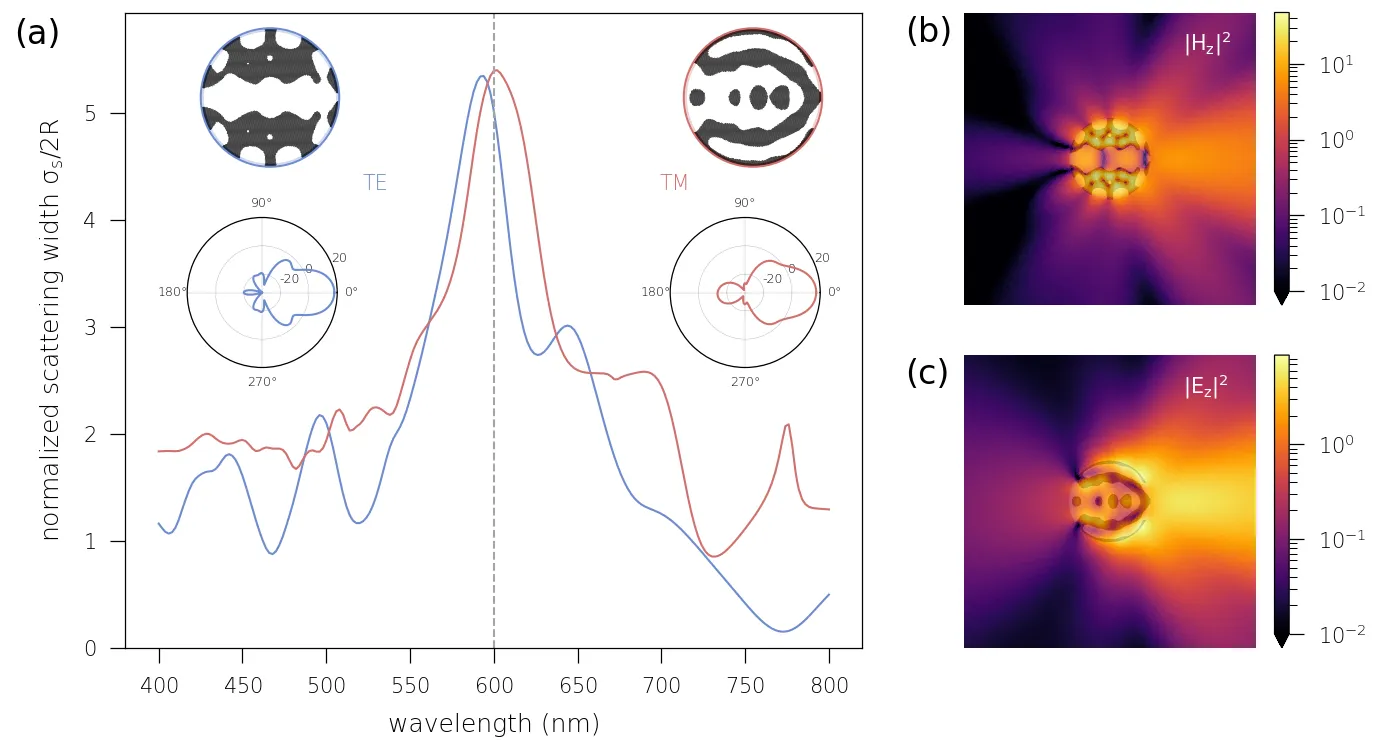
All three support automatic differentiation, so the same code that simulates a device can also optimize it. The paper walks through topology optimization examples with each of them. The figure above shows one: dielectric scatterers optimized to maximize scattering at 600 nm, for each polarization.
Read the paper
B. Vial and Y. Hao, Open-Source Computational Photonics with Auto Differentiable Topology Optimization, Mathematics 10(20), 3912 (2022). Open access, DOI