Our paper bringing quasinormal-mode theory to time-modulated media is out in Physical Review B, with an open-source Python code.
Our latest work, Quasinormal modes of Floquet media slabs, is now out in Physical Review B.
The paper brings together quasinormal-mode (QNM) theory and time-varying media. We study electromagnetic scattering by slabs whose permittivity varies periodically in time. Such a modulation couples each frequency to its harmonics, so the slab reflects and transmits light at shifted frequencies too.
What we did
- We formulate and solve the nonlinear eigenvalue problem whose solutions are the QNMs of a Floquet medium.
- We derive a reduced order model that expands the scattered field on these modes and captures the resonant physics at low cost.
- We use it to understand how the temporal modulation couples to each resonance, which enables gain and loss engineering: selectively amplifying or suppressing chosen modal contributions.
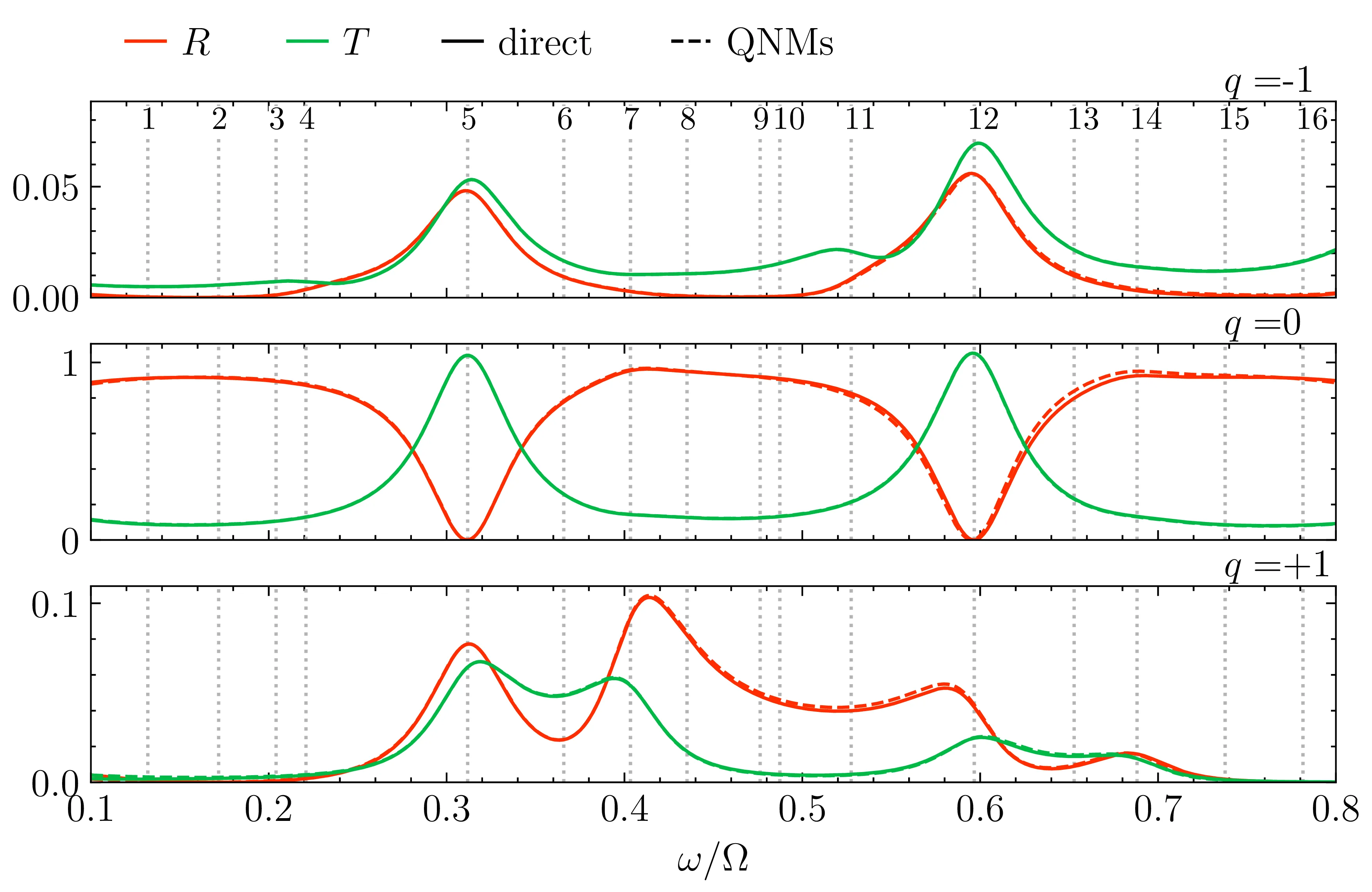
The figure above validates the approach. For the fundamental harmonic (q = 0) and the first sidebands (q = ±1), the QNM expansion (dashed) matches a direct computation (solid) across the spectrum. Dotted lines mark the real parts of the QNM frequencies.
Code
As usual, the paper comes with an open-source Python code: pytmod. For me, open source is not only about reproducibility. It also makes advanced theoretical tools easier to explore, reuse and build upon.
I am happy to discuss with anyone working on time-modulated media, resonances or non-Hermitian wave physics.
Read the paper
B. Vial and R. Craster, Quasinormal modes of Floquet media slabs, Phys. Rev. B 112, 214201 (2025). DOI