Scattering-free graded-index media that shape the amplitude and phase of electromagnetic waves, and flat graded-index lenses
Invisible inhomogeneous media
We proposed a general method to manipulate at will an electromagnetic wave propagating in a two-dimensional medium, without introducing any scattering. It yields a whole class of isotropic, spatially varying permittivity and permeability profiles that stay invisible while shaping the field magnitude and phase. A metamaterial structure working in the infrared demonstrates deep subwavelength control of the electric field amplitude with a strong reduction of scattering. This offers an alternative route to invisibility with isotropic materials, and to tailoring the propagation of light at the nanoscale.
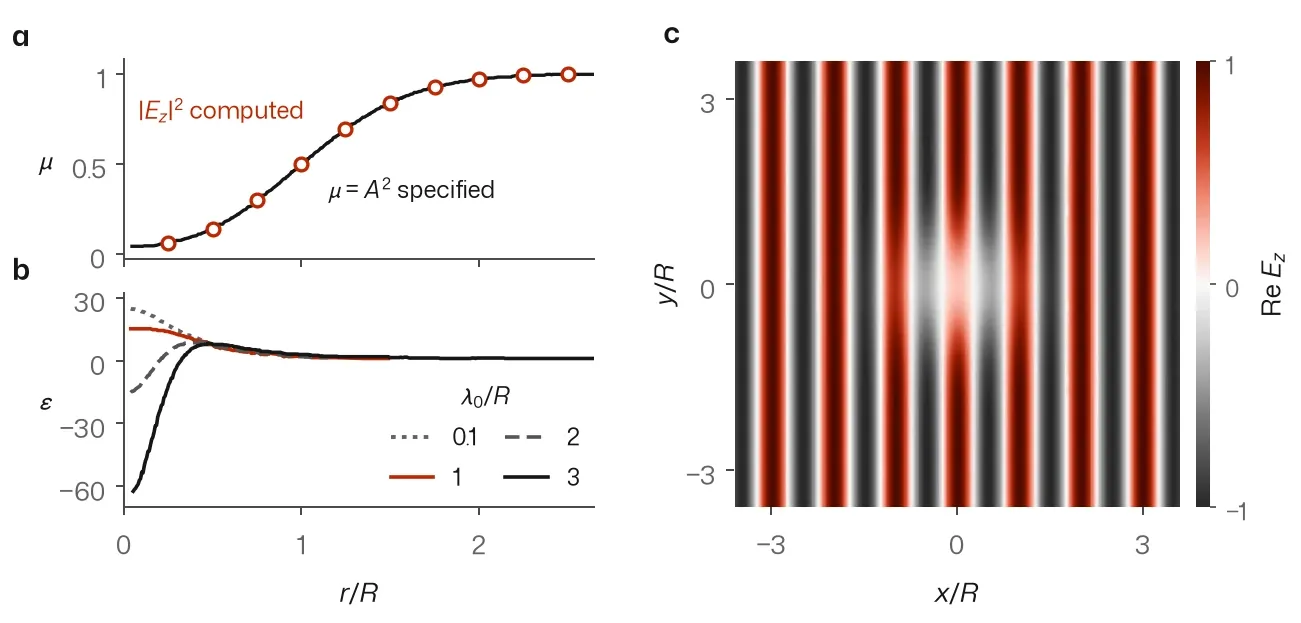
An invisible profile that damps the field by 80% at its centre. (a) Specified permeability µ = A² and computed |Ez|², (b) the matching permittivity for four wavelengths, (c) the real part of Ez for λ0/R = 1: the plane wave crosses the profile without scattering.
Phys. Rev. B 94, 245119 (2016)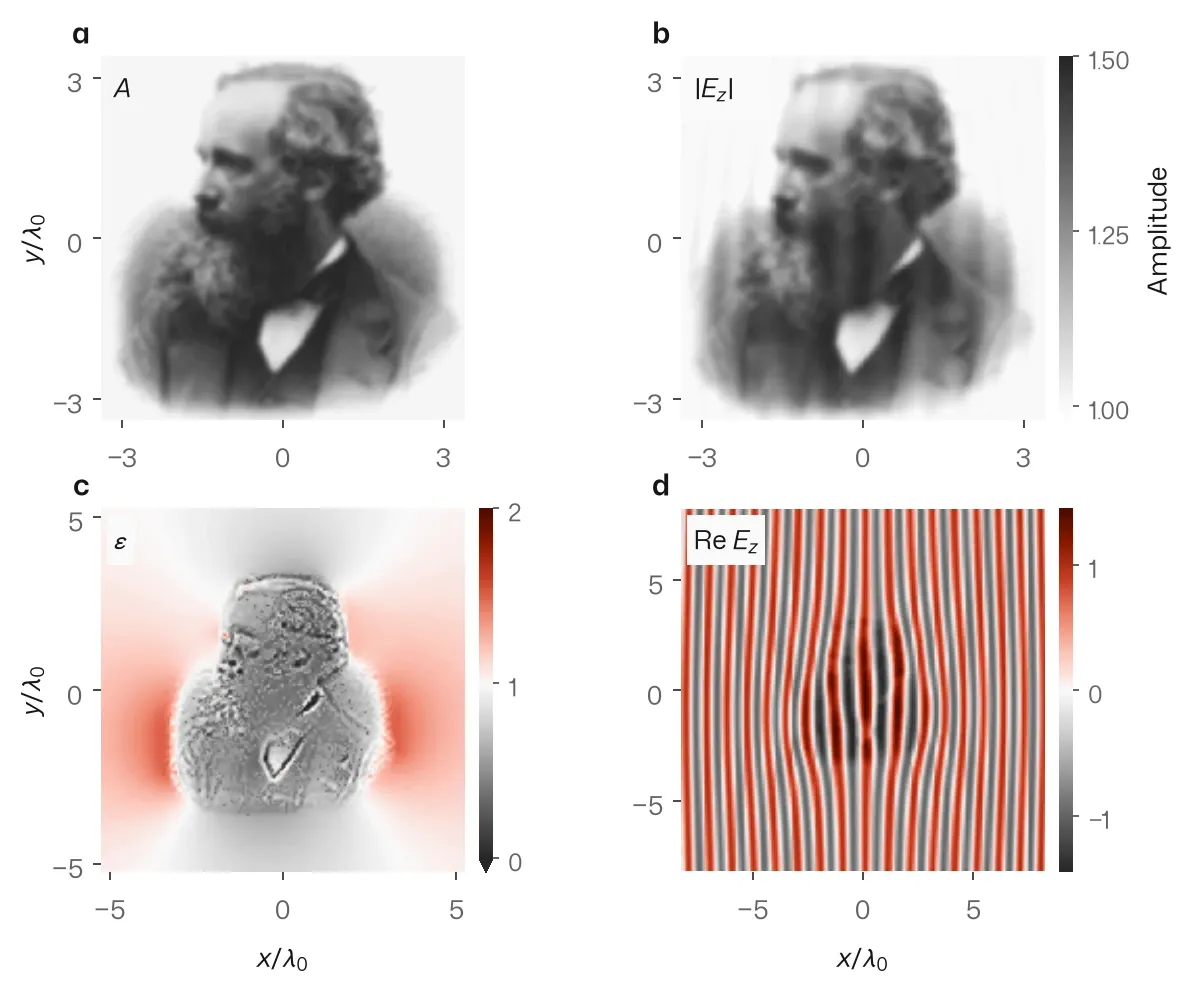
A non-magnetic invisible medium that writes a portrait of James Clerk Maxwell into the field amplitude. (a) Target amplitude, (b) computed |Ez|, (c) permittivity, (d) real part of Ez: the wavefronts bend inside the medium and come out straight.
Phys. Rev. B 94, 245119 (2016)We then extended the method to cylindrical incident waves. Separating the complex wave solution into amplitude and phase controls both independently, without resorting to transformation optics or its quasi-conformal approximations, and leads to a general class of scattering-free solutions in isotropic, inhomogeneous media.
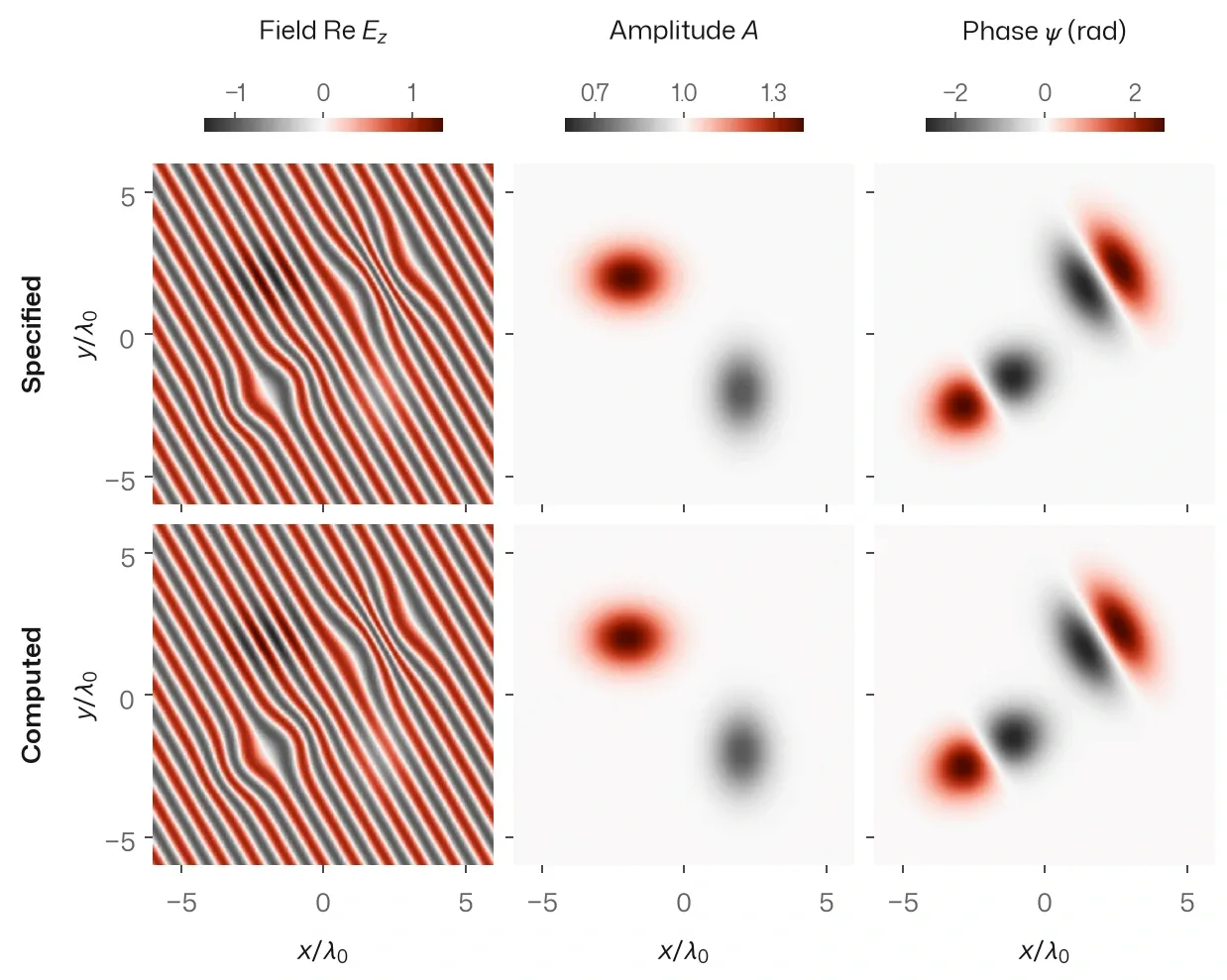
Independent control of amplitude and phase. The specified field, amplitude and phase (top) are reproduced by solving the wave equation in the designed medium (bottom).
Phys. Rev. B 94, 245119 (2016)Related articles
- B. Vial, Y. Liu, S. Horsley, T. Philbin, and Y. Hao, A class of invisible inhomogeneous media and the control of electromagnetic waves. Phys. Rev. B 94(24):245119, (2016) DOI
- Y. Liu, B. Vial, S. Horsley, T. Philbin, and Y. Hao, Direct manipulation of wave amplitude and phase through inverse design of isotropic media. New J. Phys. 19(7):073010, (2017) DOI
Flat Luneburg lens
Graded-index profiles also make compact lenses. We designed a simplified flat Luneburg lens with transformation electromagnetics and fabricated it by casting ceramic composites. With only six layers and a highest permittivity of 12, it scans ±30° with gains of at least 18 dBi from 57 to 66 GHz, and carried raw high-definition video over a wireless link at scan angles up to 36°.
Related article
- R. Foster, D. Nagarkoti, J. Gao, B. Vial, F. Nicholls, C. Spooner, S. Haq, and Y. Hao, Beam-Steering Performance of Flat Luneburg Lens at 60 GHz for Future Wireless Communications. Int. J. Antenn. Propag. 2017, 7932434 (2017) DOI