Resonant metamaterial absorbers, annular aperture metasurfaces for infrared spectral filtering, and silicon Mie resonators
Metamaterials are artificial materials made of subwavelength inclusions, with electromagnetic properties not found in nature. During our work on infrared multispectral imaging, we used modal analysis to understand resonant metamaterial filters, then designed, fabricated and measured them.
Metal insulator metal resonant filters
We carried out a modal analysis of metal–insulator–metal (MIM) metamaterials in the far infrared. These structures act as resonant reflection bandcut filters, independent of the polarization and direction of incidence. We showed that the resonant reflection dip comes from the excitation of quasimodes (modes associated with a complex frequency), which leads to quasi-total absorption.
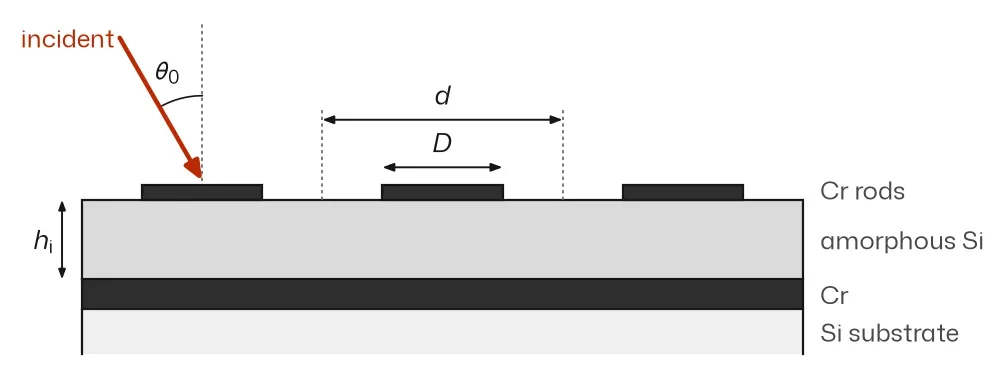
Cross-section of the absorber: chromium rods (diameter D, period d) on amorphous silicon over a chromium film, on a silicon substrate. The vertical scale is stretched three times.
J. Opt. Soc. Am. B 31, 1339 (2014)We fabricated large-area samples made of chromium nanorod gratings on top of Si/Cr layers on a silicon substrate. Fourier transform spectrophotometry measurements agree well with finite element simulations. A quasimodal expansion gives a minimal resonant model that fits the full-wave simulations and reveals the excitation conditions of the modes.
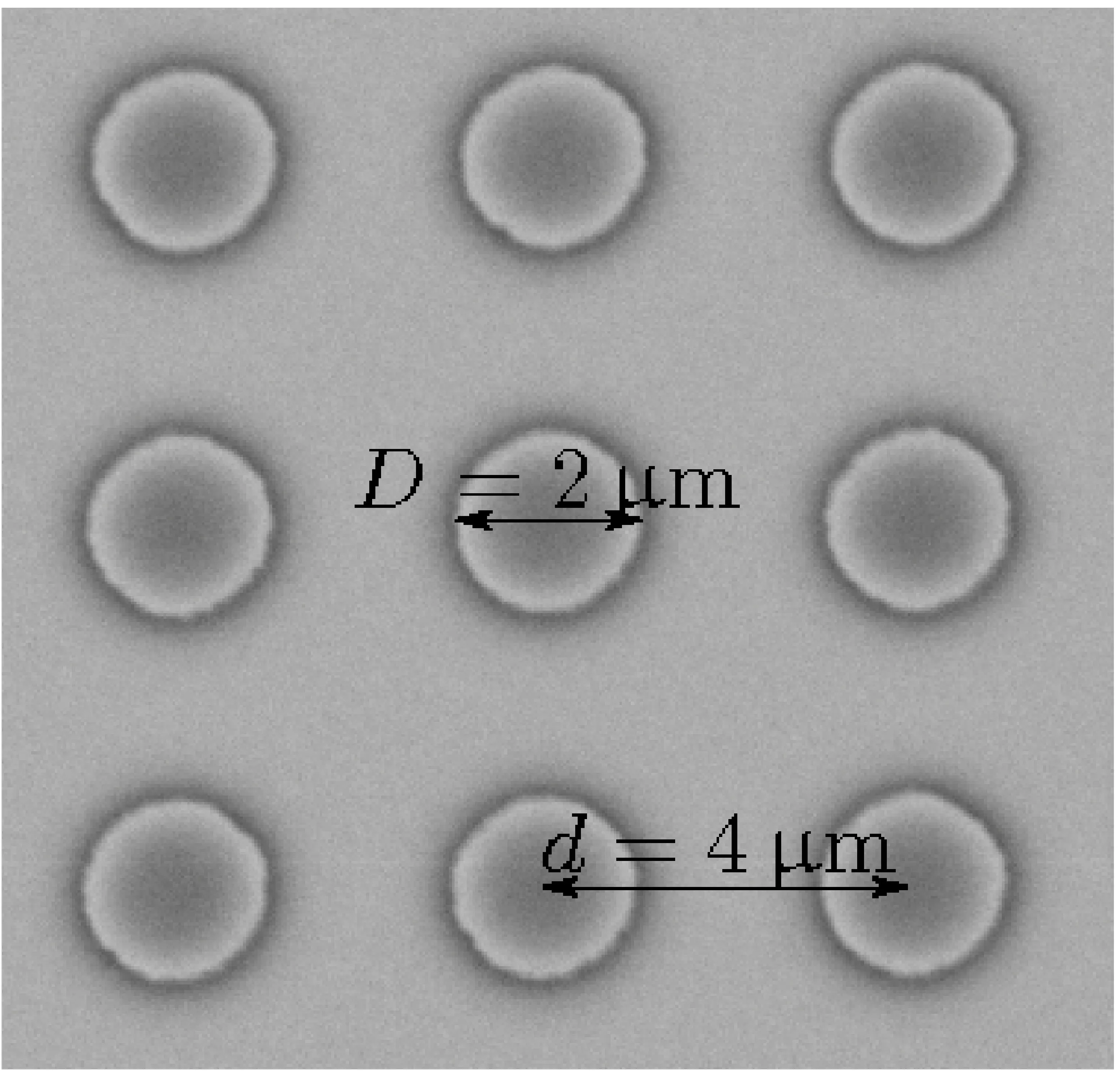
Top view of a fabricated grating under the scanning electron microscope (D = 2 µm, d = 4 µm).
J. Opt. Soc. Am. B 31, 1339 (2014)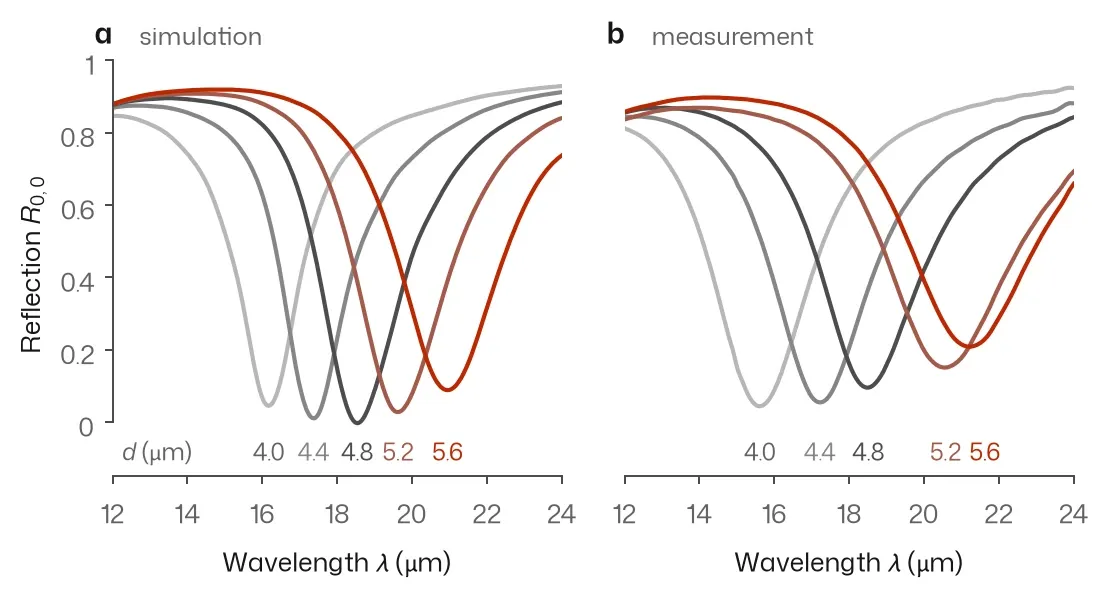
Reflection at normal incidence for periods d from 4.0 to 5.6 µm, (a) computed with finite elements and (b) measured by FTIR. The dip moves to longer wavelengths as d grows, and reflection almost vanishes (near-total absorption) at d = 4.8 µm.
J. Opt. Soc. Am. B 31, 1339 (2014)Related article
- B. Vial, G. Demésy, F. Zolla, A. Nicolet, M. Commandré, C. Hecquet, T. Begou, S. Tisserand, S. Gautier, and V. Sauget, Resonant metamaterial absorbers for infrared spectral filtering: Quasimodal analysis, design, fabrication, and characterization. J. Opt. Soc. Am. B 31(6):1339, (2014) DOI
Annular aperture metasurfaces
We studied the diffractive behavior of arrays of square coaxial apertures in a gold layer. Their resonant transmission enhancement makes tunable bandpass filters for multispectral imaging in the 7–13 μm range. A modal analysis guided the design and showed that the resonance peak comes from the excitation of leaky modes of the open photonic structure. FTIR transmission measurements of samples on silicon agree well with the numerical results and show an angular tolerance of the fabricated filters up to 30°.
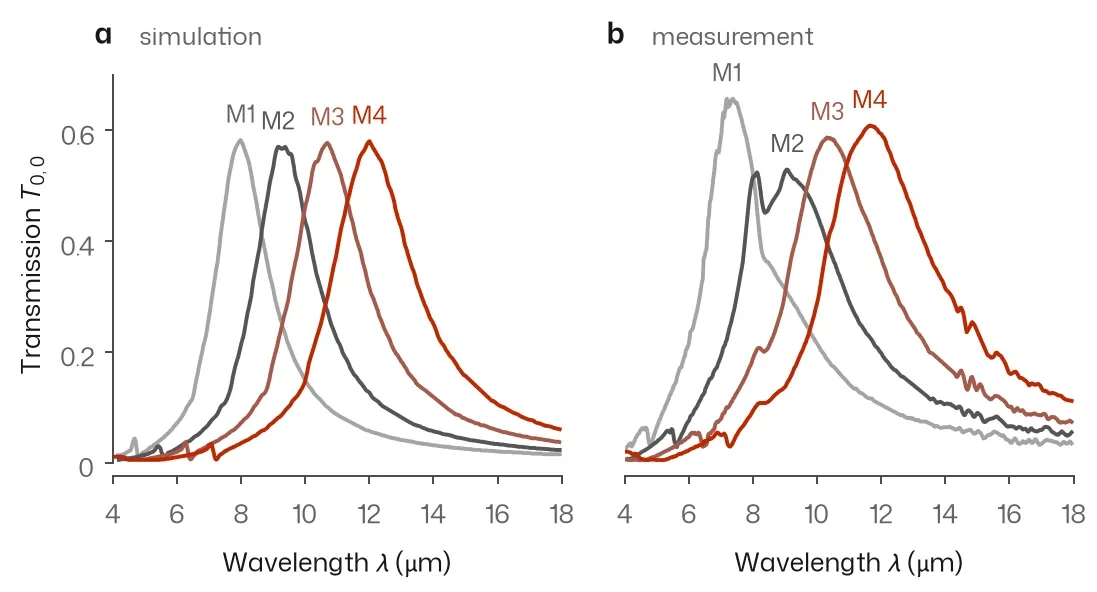
Transmission at normal incidence of the four coaxial aperture filters M1 to M4, (a) computed and (b) measured by FTIR. Each filter passes a band centred between 8 and 12 µm, with a peak transmission near 60%.
Opt. Lett. 39, 4723 (2014)Related articles
- B. Vial, M. Commandré, G. Demésy, A. Nicolet, F. Zolla, F. Bedu, H. Dallaporta, S. Tisserand, and L. Roux, Transmission enhancement through square coaxial aperture arrays in metallic film: When leaky modes filter infrared light for multispectral imaging. Opt. Lett. 39(16):4723, (2014) DOI
- M. Commandré, B. Vial, S. Tisserand, L. Roux, H. Dallaporta, F. Bedu, G. Demésy, A. Nicolet, and F. Zolla, Design, fabrication and characterization of resonant metamaterial filters for infrared multispectral imaging. Thin Solid Films, (2015) DOI
Silicon Mie resonators
Subwavelength dielectric Mie resonators combine the advantages of dielectric microstructures and of metallic nanoparticles supporting surface plasmons. We fabricated monocrystalline silicon resonators over large scales by spontaneous dewetting of commercial silicon-on-insulator substrates. The resonators feature two resonant modes in the visible spectrum, and assisting the dewetting with electron beam lithography or focused ion beam patterning controls their size, position and arrangement, down to complex multimers.
Related article
- M. Abbarchi, M. Naffouti, B. Vial, A. Benkouider, L. Lermusiaux, L. Favre, A. Ronda, S. Bidault, I. Berbezier, and N. Bonod, Wafer Scale Formation of Monocrystalline Silicon-Based Mie Resonators via Silicon-on-Insulator Dewetting. ACS Nano 8(11):11181, (2014) DOI